
Understanding Bridge Loans for Residential and Commercial Properties: A Complete Guide
Bridge loans are specialized, short-term financing instruments designed to provide immediate capital, effectively bridging the gap between a present funding requirement and a future, long-term financial solution. For real estate investors, developers, and business owners, securing capital quickly is often the determining factor in capitalizing on a lucrative opportunity or losing it to a competitor. Traditional bank financing, while offering lower interest rates, typically requires months of underwriting, making it incompatible with fast-paced real estate transactions. Bridge loans solve this liquidity problem by prioritizing the collateral’s value and the project’s viability over the borrower’s historical tax returns or income.
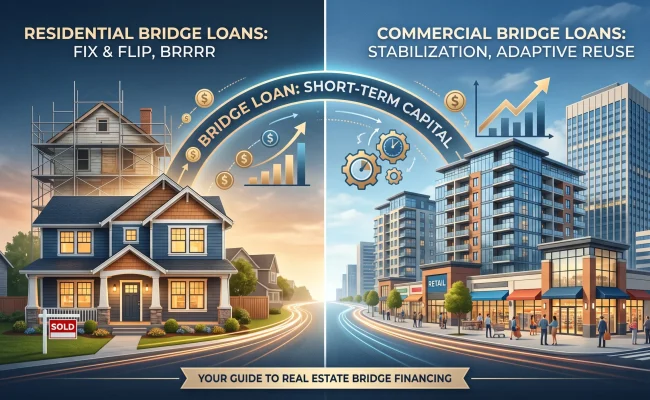
Deep Dive into Residential Bridge Loans
The residential bridge loan is a foundational tool for real estate investors focused on single-family properties, condos or townhomes, small multifamily properties (2-4 units), and residential redevelopment. In this sector, bridge financing is frequently associated with hard money lending, where private lenders provide capital based primarily on the asset’s potential rather than the borrower’s personal income or financial strength.
Common Use Cases in Residential Investing
The Fix-and-Flip Strategy
The most prevalent use of a residential bridge loan is funding a fix-and-flip project. Investors locate distressed properties that are not financeable through conventional lenders due to deferred maintenance or being uninhabitable. Real estate investor loans bridge this gap by funding both the initial acquisition and the subsequent renovation costs. The lender evaluates the After Repair Value (ARV) of the property, typically lending up to 70% or 75% of this future value. Funds for the renovation are held in escrow and released through a draw schedule as the investor completes specific construction milestones. These short-term property loans empower borrowers to acquire, renovate, and stabilize real estate assets rapidly before transitioning into permanent financing or executing a sale.
Cash-Out Refinancing and Property Seasoning
Investors utilizing the BRRRR (Buy, Rehab, Rent, Refinance, Repeat) strategy heavily rely on short-term property loans. After an investor purchases and rehabilitates a property, conventional lenders often require a “seasoning period”—a timeframe ranging from six to twelve months where the property must be leased and operational before they will underwrite a long-term permanent rental loan. A residential bridge loan allows the investor to execute a cash-out refinance immediately after the rehab is complete. This frees up the investor’s trapped equity to purchase their next project while they wait for the seasoning period to expire, at which point they refinance the bridge loan into a 30-year conventional or DSCR (Debt Service Coverage Ratio) mortgage.
Borrowers typically must bring a minimum of 10% to 20% of the total project cost to the closing table as "skin in the game."
Lenders evaluate the investor's experience and credit score. A borrower with good credit and five successful flips in the past year will receive significantly better interest rates and higher leverage than a first-time investor.
Lenders require proof of liquid reserves to cover unexpected construction overruns and the monthly interest payments during the renovation phase.
Deep Dive into Commercial Bridge Loans
Commercial real estate financing operates on a larger, more complex scale. Commercial bridge loans are critical for institutional and middle-market developers dealing with multifamily complexes (5+ units), retail centers, office buildings, and industrial warehouses. Traditional commercial lenders require properties to be “stabilized”—meaning they maintain high occupancy and generate consistent cash flow—before they will issue a permanent mortgage. Commercial bridge loans provide the capital necessary to reach that stabilization point.
Common Use Cases in Commercial Investing
Property Stabilization and Value-Add Strategies
When an investor purchases a half-empty apartment building with rents substantially below the market rate, conventional commercial real estate financing is unavailable because the current net operating income (NOI) cannot support the required debt service. A commercial bridge loan funds the acquisition and the capital expenditures (CapEx) needed to upgrade the units. As the units are modernized and leased at higher market rates, the property’s NOI increases. Once occupancy reaches 90% or higher, the asset is considered stabilized and ready for permanent financing.
Transforming an obsolete asset into a higher-and-better use requires massive capital and entails significant zoning and construction risks. Examples include converting an abandoned textile mill into luxury loft apartments or repurposing an empty big-box retail store into a self-storage facility. Commercial bridge loans provide the heavy-lift construction capital required for these adaptive reuse projects. Because these properties do not generate income during the transition, the bridge loan is underwritten entirely on the projected future cash flows and the localized demand for the new asset class.
In periods of economic transition, commercial properties often face foreclosure or maturity defaults, forcing current owners to sell at a steep discount. To secure these distressed assets, buyers must frequently close within 14 to 30 days. Commercial bridge loans act as transactional fuel, allowing a sponsor to close quickly, secure the asset, and figure out the long-term capital stack later.
In commercial bridge lending, the exit strategy is the most heavily scrutinized component of the underwriting process. A bridge loan is temporary by nature, typically carrying a term of 12 to 36 months. The lender must have absolute clarity on how they will be repaid. The two standard exits are:
Transitioning into a long-term, lower-interest facility such as a Fannie Mae/Freddie Mac agency loan, a commercial bank loan, or a CMBS (Commercial Mortgage-Backed Securities) loan once the property achieves target NOI.
Listing and selling the stabilized property on the open market to a turnkey investor or institutional buyer.
Lenders will stress-test the borrower’s exit strategy by analyzing market capitalization rates, localized tenant demand, and future interest rate projections to ensure the permanent loan or sale proceeds will be sufficient to retire the bridge debt.
Weighing the Pros and Cons
Utilizing bridge loans and hard money lending requires a precise understanding of the inherent benefits and the associated risks.
The Benefits of Bridge Financing
Bridge loans can often close in two to three weeks, compared to the 60 to 90 days required for traditional bank financing, allowing investors to win competitive bids.
Because lenders focus on the asset's business plan rather than standardized personal credit matrices, they can fund complex, out-of-the-box deals that banks automatically reject.
The vast majority of bridge loans require only monthly interest payments. By eliminating the principal paydown during the loan term, borrowers preserve maximum operational cash flow while they renovate and lease the property.
For larger commercial bridge loans, lenders may offer non-recourse terms, meaning the borrower is not personally liable for the debt beyond the property itself, provided they do not commit fraud or trigger specific "bad boy" carve-outs.
The Risks and Hidden Costs
Because bridge lenders absorb the risk of a non-stabilized asset, their interest rates typically sit several percentage points higher than conventional prime rates.
Borrowers must factor in upfront costs, typically ranging from 1% to 3% of the total loan amount (points), alongside appraisal and legal fees.
Some commercial bridge loans enforce a minimum interest guarantee or a yield maintenance penalty, penalizing borrowers who finish their project and attempt to pay off the loan too early.
The greatest risk of a short-term property loan is maturity default. If the real estate market shifts, construction is delayed, or permanent interest rates spike, the borrower may find themselves unable to sell or refinance before the bridge loan expires, potentially leading to foreclosure.
To determine the most efficient capital stack for your next acquisition, connect with a specialized commercial mortgage broker or real estate financial advisor who can align your project’s specific timeline and risk profile with the right private lending partner. What specific asset class are you currently targeting for your next value-add project?